The two-year guarantee: your rights when goods turn out to be faulty
The EU two-year guarantee on faulty goods, and the new repair extension | Linxei
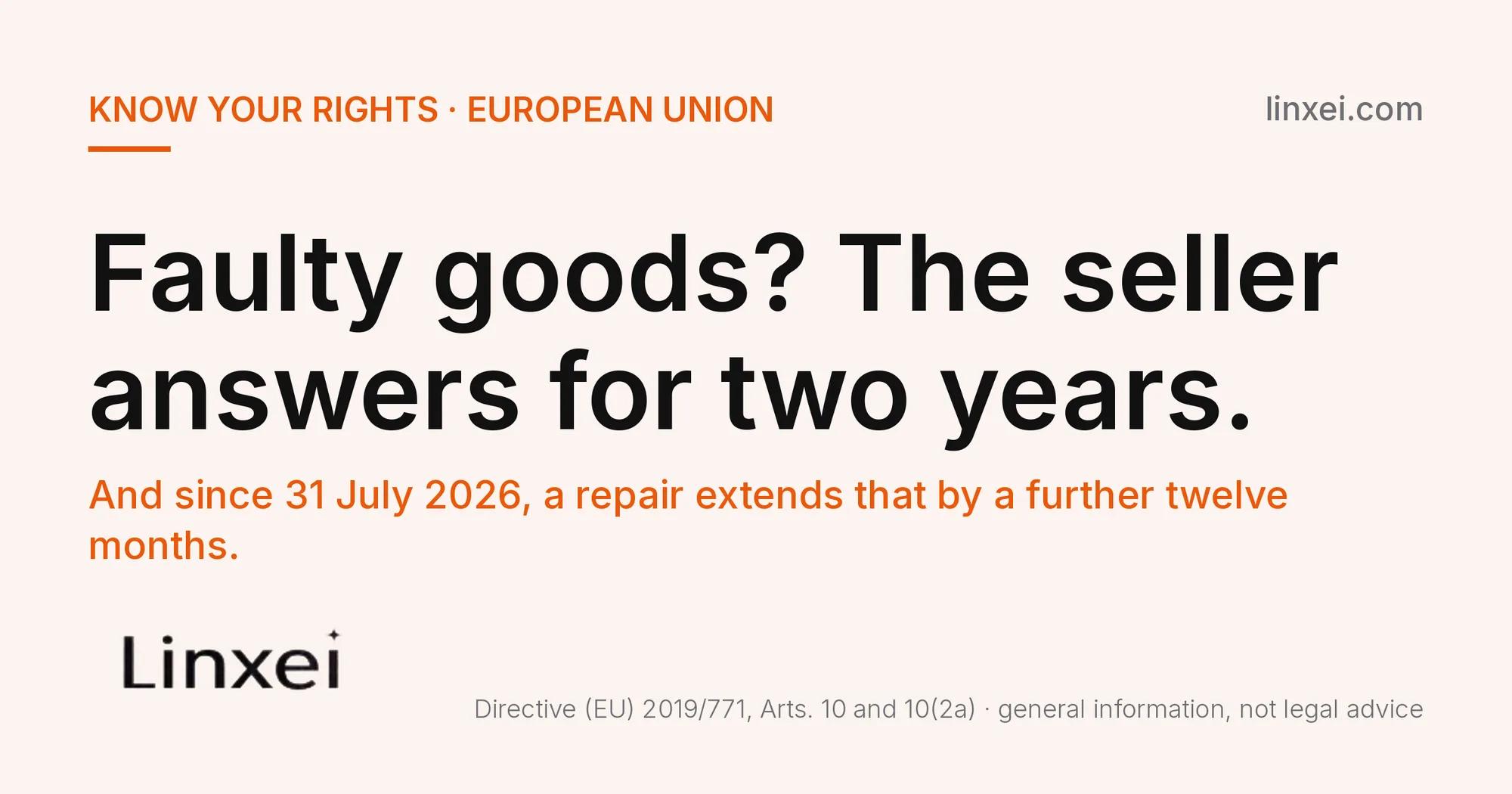
Anywhere in the EU, the seller is liable for a lack of conformity that existed at delivery and becomes apparent within two years (Article 10(1) of Directive (EU) 2019/771). Since 31 July 2026 there is something new: where the seller repairs the goods, the liability period is extended once by a further twelve months (Article 10(2a), inserted by Directive (EU) 2024/1799).
This article contains general information, not legal advice. What applies to your situation depends on your own circumstances, and on the national law of the country where you bring your claim.
Two years, and sometimes longer
The two-year period runs from delivery, and Member States may set longer periods (Article 10(1) and 10(3) of Directive (EU) 2019/771). This is a legal right against the seller, not a favour, and it applies to goods bought from a trader; goods bought from a private individual are outside these rules (Your Europe on guarantees).
The new twelve months after a repair
If a repair is what brings the goods back into conformity, the liability period is extended once by twelve months (Article 10(2a) of Directive (EU) 2019/771). The seller must also tell you, before providing the remedy, that you can choose between repair and replacement and that a repair may extend the period (Article 13(2a)). Both provisions were inserted by the so-called right to repair Directive and took effect on 31 July 2026 (Directive (EU) 2024/1799), so guidance written before that date, including some official pages, does not yet reflect them.
Who has to prove what
For the first year, a fault that appears is presumed to have existed at delivery, so you do not have to prove it; the seller must prove otherwise. Member States may extend that presumption to two years, and some have (Articles 11(1) and 11(2) of Directive (EU) 2019/771). The presumption is not absolute: it does not apply where it would be incompatible with the nature of the goods or of the fault, for example with obviously perishable items or damage you plainly caused.
What you can ask for, and in what order
You can first require the goods to be brought into conformity, choosing between repair and replacement, unless your choice is impossible or would impose disproportionate costs on the seller compared with the other option (Article 13(1) and 13(2) of Directive (EU) 2019/771). A price reduction or termination of the contract comes second, but you do not always have to wait: those remedies are available immediately where the fault is serious enough to justify it, where a fault reappears after an attempted repair, where the seller has refused to put it right, or where it is clear the seller will not do so within a reasonable time (Article 13(4)). You cannot terminate for a minor fault, and it is for the seller to prove the fault is minor (Article 13(5)).
Free of charge means free
Repairs and replacements must be carried out free of charge, within a reasonable time and without significant inconvenience to you (Article 14(1) of Directive (EU) 2019/771), and free of charge is defined in the Directive itself as free of the necessary costs of bringing the goods into conformity, in particular postage, carriage, labour and materials (Article 2(14)). Since 31 July 2026 the seller may lend you a replacement, including a refurbished one, while yours is being repaired, and may supply a refurbished item as the replacement if you expressly ask for one (Article 14(1), as amended).
This is not the shop's own warranty
A commercial guarantee from the seller or manufacturer sits on top of your legal rights and cannot cut them down. Any commercial guarantee statement must say clearly that you are entitled by law to free remedies from the seller for a lack of conformity, and that the commercial guarantee does not affect them (Article 17(2)(a) of Directive (EU) 2019/771). Where a producer offers a commercial guarantee of durability, the producer is liable to you directly for repair or replacement throughout it (Article 17(1)).
How Linxei can help
A lawyer can tell you where you stand, put the claim properly and deal with the other side. Linxei is the platform where you describe your legal problem in your own words and verified independent lawyers send you fixed-fee offers. You choose. Jenni AI, our artificial intelligence, helps only to structure your request; it does not give legal advice, and a human lawyer always stays at the centre.
Have a legal question of your own?
Linxei is building AI-matched legal help with human justice at its heart. Add your voice and be first in line.
Add your voiceJennifer leads Linxei’s mission to make justice accessible, drawing on years inside the legal industry.
LinkedInRelated articles
Flight delayed or cancelled: what EU law entitles you to
Flight delay compensation in the EU: 250, 400 or 600 euro | Linxei
9 August 2026 · 4 min read
Suing across borders: the European Small Claims Procedure
European Small Claims Procedure: claims up to 5,000 euro across the EU | Linxei
9 August 2026 · 3 min read
The 14-day cooling-off period for online and doorstep purchases
14-day right of withdrawal: cancelling an online order in the EU | Linxei
9 August 2026 · 3 min read