The 14-day cooling-off period for online and doorstep purchases
14-day right of withdrawal: cancelling an online order in the EU | Linxei
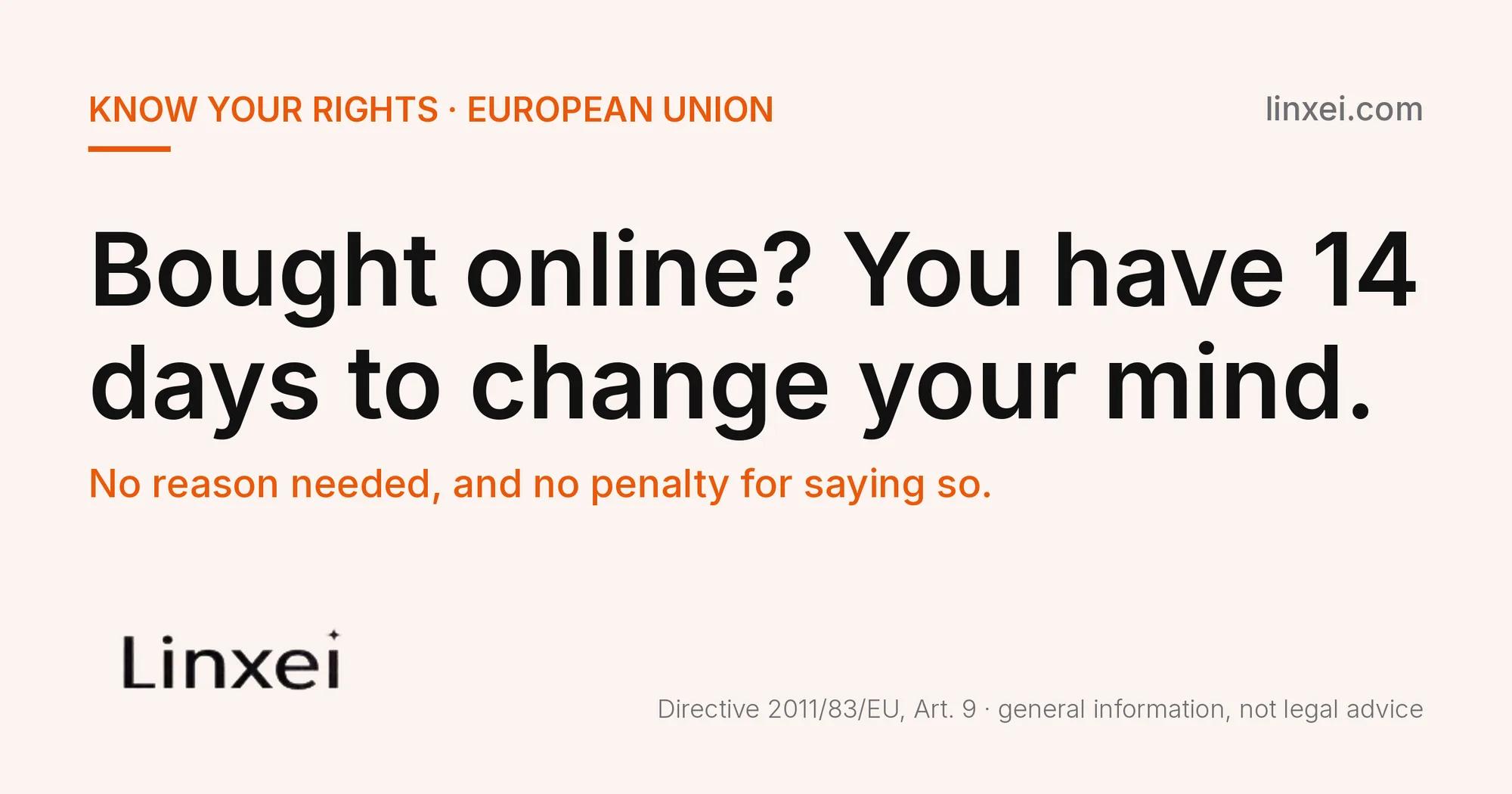
Buy at a distance or away from a trader's premises in the EU and you generally have 14 days to withdraw, without giving any reason and without penalty (Article 9(1) of Directive 2011/83/EU). The right is strong, but it has a defined list of exceptions and some traps about who pays what.
This article contains general information, not legal advice. What applies to your situation depends on your own circumstances, and on the national law of the country where you bring your claim.
When the 14 days start
For services, the period runs from the day the contract was concluded. For goods, it runs from the day you or someone you nominated, other than the carrier, takes physical possession of them. Where an order arrives in several deliveries, the clock starts with the last item, and for goods delivered in lots or pieces, with the last lot or piece (Article 9(2) of Directive 2011/83/EU; in plain language, Your Europe on returns). One national variation worth knowing: Member States may extend the period to 30 days for contracts made during unsolicited visits to your home or on organised excursions, and several have (Article 9(1a)).
If the trader never told you about the right
The period does not simply lapse. Where the trader failed to give you the required information about the right of withdrawal, the deadline expires twelve months after the end of the initial 14-day period. If the trader supplies the information within that year, you then have 14 days from the day you receive it (Article 10 of Directive 2011/83/EU).
What is excluded
The exceptions are listed exhaustively, and the main ones are: goods made to your specifications or clearly personalised; goods liable to deteriorate or expire rapidly; sealed goods unsuitable for return on health or hygiene grounds once unsealed; sealed audio, video or software once unsealed; newspapers and magazines, though not subscriptions; goods at a public auction; and accommodation other than for residential purposes, transport of goods, car rental, catering and leisure services where the contract fixes a specific date or period of performance (Article 16 of Directive 2011/83/EU). Two of these are commonly misstated. The travel exclusion is that closed list, not travel generally. And for digital content supplied without a tangible medium, the exception applies only where all three conditions are met: your prior express consent to begin during the period, your acknowledgement that you thereby lose the right, and the trader's confirmation of the contract (Article 16(m)).
Who pays to send it back
You bear the direct cost of returning the goods, unless the trader agreed to bear it or failed to tell you before the purchase that you would have to (Article 14(1) of Directive 2011/83/EU; Your Europe on returns). You must send the goods back within 14 days of telling the trader you are withdrawing, and dispatch within that window is enough. You can handle and inspect the goods as you would in a shop; you are liable only for value lost through handling beyond what is needed to establish their nature, characteristics and functioning, and not even for that if the trader never told you about the right (Article 14(2)).
When the money must come back
The trader must reimburse all payments received, including the costs of delivery, without undue delay and no later than 14 days from being informed of your decision, using the same means of payment you used (Article 13(1) of Directive 2011/83/EU). Two qualifications matter in practice: if you chose a more expensive delivery than the cheapest standard option, only the standard rate is refundable (Article 13(2)); and unless the trader offered to collect the goods, it may withhold the refund until it receives them back or you provide evidence of having sent them, whichever comes first (Article 13(3)).
How Linxei can help
A lawyer can tell you where you stand, put the claim properly and deal with the other side. Linxei is the platform where you describe your legal problem in your own words and verified independent lawyers send you fixed-fee offers. You choose. Jenni AI, our artificial intelligence, helps only to structure your request; it does not give legal advice, and a human lawyer always stays at the centre.
Have a legal question of your own?
Linxei is building AI-matched legal help with human justice at its heart. Add your voice and be first in line.
Add your voiceJennifer leads Linxei’s mission to make justice accessible, drawing on years inside the legal industry.
LinkedInRelated articles
Flight delayed or cancelled: what EU law entitles you to
Flight delay compensation in the EU: 250, 400 or 600 euro | Linxei
9 August 2026 · 4 min read
Suing across borders: the European Small Claims Procedure
European Small Claims Procedure: claims up to 5,000 euro across the EU | Linxei
9 August 2026 · 3 min read
The two-year guarantee: your rights when goods turn out to be faulty
The EU two-year guarantee on faulty goods, and the new repair extension | Linxei
9 August 2026 · 3 min read