Flight delayed or cancelled: what EU law entitles you to
Flight delay compensation in the EU: 250, 400 or 600 euro | Linxei
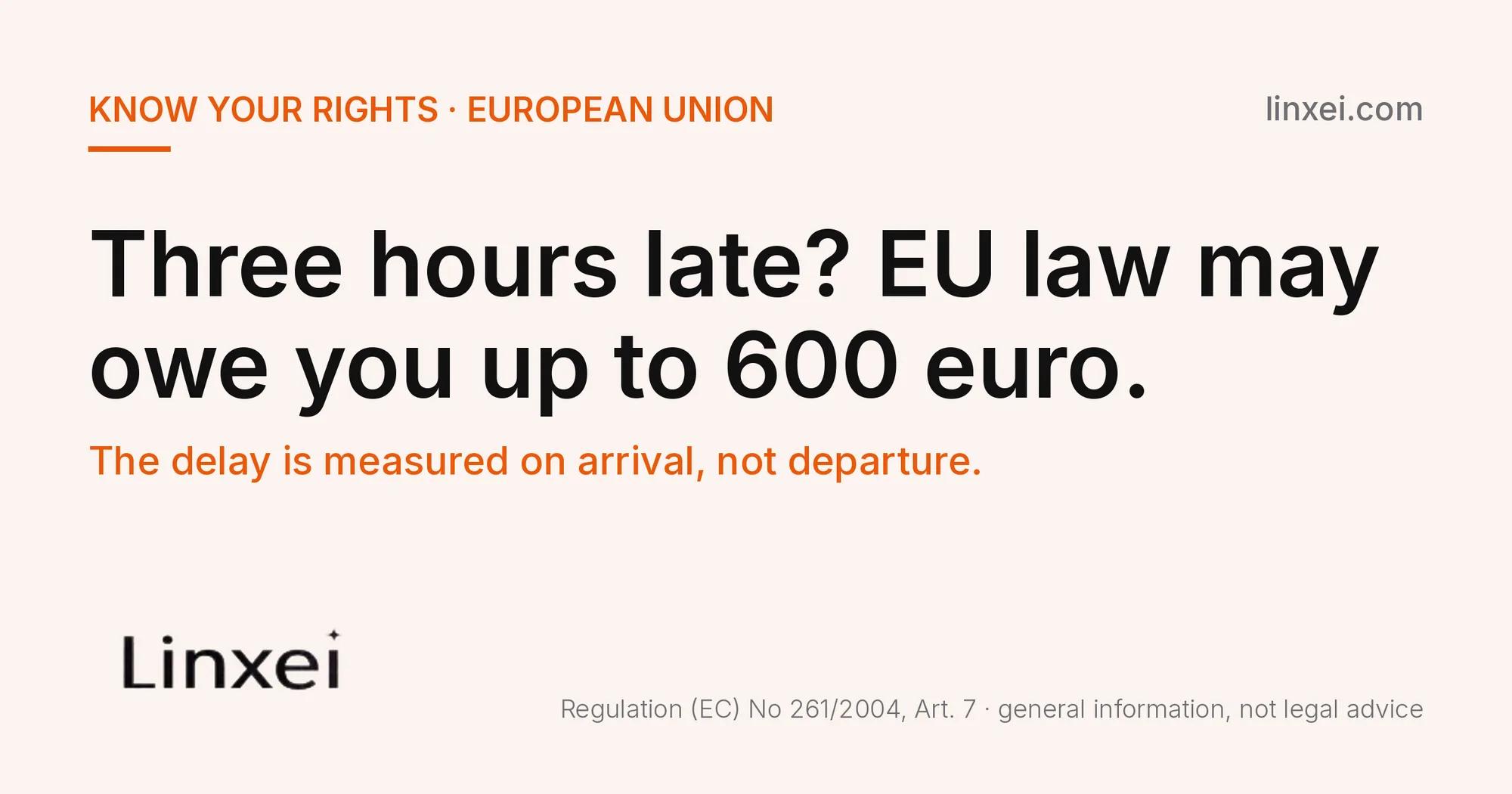
If your flight is cancelled, or you arrive at your destination three hours or more late, EU law may entitle you to compensation of 250, 400 or 600 euro depending on the distance, on top of your refund or re-routing (Article 7 of Regulation (EC) No 261/2004). The airline can escape the compensation, but only in defined circumstances, and never the duty to look after you while you wait.
This article contains general information, not legal advice. What applies to your situation depends on your own circumstances, and on the national law of the country where you bring your claim.
Which flights are covered
The Regulation covers passengers departing from an airport in an EU Member State, whichever airline is flying, and passengers arriving in the EU from a third country where the operating carrier is an EU carrier and they received no benefits or assistance in that third country (Article 3(1) of Regulation 261/2004). It also applies to flights to and from Iceland, Norway and Switzerland (Your Europe, air passenger rights). It does not cover the United Kingdom, which has its own equivalent rules since leaving the EU. You need a confirmed reservation, and to have presented for check-in on time, generally not later than 45 minutes before departure (Article 3(2)).
How much compensation
The amounts are fixed by distance, measured by the great circle route: 250 euro for flights of 1,500 km or less, 400 euro for intra-EU flights of more than 1,500 km and for other flights between 1,500 and 3,500 km, and 600 euro for all other flights (Article 7(1) and 7(4) of Regulation 261/2004). Where the airline re-routes you and you arrive within two, three or four hours of your original arrival time depending on the band, it may halve the compensation (Article 7(2)).
The three-hour rule, which is not in the Regulation
The text of the Regulation gives compensation for cancellation and denied boarding, not for delay. The Court of Justice closed that gap: passengers who reach their final destination three hours or more after the scheduled arrival time are entitled to the same compensation as passengers whose flight was cancelled (Sturgeon, Joined Cases C-402/07 and C-432/07), a ruling the Grand Chamber confirmed when the airline industry challenged it (Nelson, Joined Cases C-581/10 and C-629/10; see also the Commission's interpretative guidelines, 2016/C 214/04). Note what is measured: arrival at your final destination, not departure.
When the airline does not have to pay
There is no compensation if the airline proves that the disruption was caused by extraordinary circumstances which could not have been avoided even if all reasonable measures had been taken (Article 5(3) of Regulation 261/2004). The burden is on the airline, and the category is narrower than airlines often suggest: the Court held in Sturgeon that a technical problem in an aircraft is not in itself an extraordinary circumstance, unless it stems from events not inherent in the normal exercise of the carrier's activity (Sturgeon, ruling 3).
What you get even when there is no compensation
The duty of care is separate and survives extraordinary circumstances. Once the delay passes two hours for short flights, three for intra-EU flights over 1,500 km, or four for the longest flights, the airline must provide meals and refreshments in reasonable relation to the waiting time, hotel accommodation and transfers where an overnight stay becomes necessary, and two free telephone calls, faxes or emails (Articles 6 and 9 of Regulation 261/2004). From five hours you can abandon the journey and claim a refund of the unused part of the ticket within seven days, or take re-routing at the earliest opportunity or at a later date that suits you (Article 8(1)).
How long you have to claim
The Regulation sets no deadline. The Court of Justice held that the time limit for bringing a claim is a matter for the national law of each Member State (Cuadrench Moré, Case C-139/11), and those periods vary widely across the EU, from around a year to several years. That is the single most important practical reason not to leave a claim sitting. Your rights cannot be signed away by the airline's terms (Article 15), and compensation under the Regulation is without prejudice to further damages you may be able to claim (Article 12).
One change on the horizon
A long-negotiated reform of these rules was finally adopted by the Council on 13 July 2026, after the European Parliament approved the joint conciliation text on 7 July 2026. It had not been published in the Official Journal as at the date of this article, and according to the Council's own announcement the new rules will enter into force twelve months and twenty days after publication. Until then, Regulation 261/2004 as described here continues to apply unchanged. When the new regime arrives it is expected to write the three-hour threshold into the legislation itself and keep the 250, 400 and 600 euro amounts largely as they are.
How Linxei can help
A lawyer can tell you where you stand, put the claim properly and deal with the other side. Linxei is the platform where you describe your legal problem in your own words and verified independent lawyers send you fixed-fee offers. You choose. Jenni AI, our artificial intelligence, helps only to structure your request; it does not give legal advice, and a human lawyer always stays at the centre.
Have a legal question of your own?
Linxei is building AI-matched legal help with human justice at its heart. Add your voice and be first in line.
Add your voiceJennifer leads Linxei’s mission to make justice accessible, drawing on years inside the legal industry.
LinkedInRelated articles
Suing across borders: the European Small Claims Procedure
European Small Claims Procedure: claims up to 5,000 euro across the EU | Linxei
9 August 2026 · 3 min read

The 14-day cooling-off period for online and doorstep purchases
14-day right of withdrawal: cancelling an online order in the EU | Linxei
9 August 2026 · 3 min read
The two-year guarantee: your rights when goods turn out to be faulty
The EU two-year guarantee on faulty goods, and the new repair extension | Linxei
9 August 2026 · 3 min read