Suing across borders: the European Small Claims Procedure
European Small Claims Procedure: claims up to 5,000 euro across the EU | Linxei
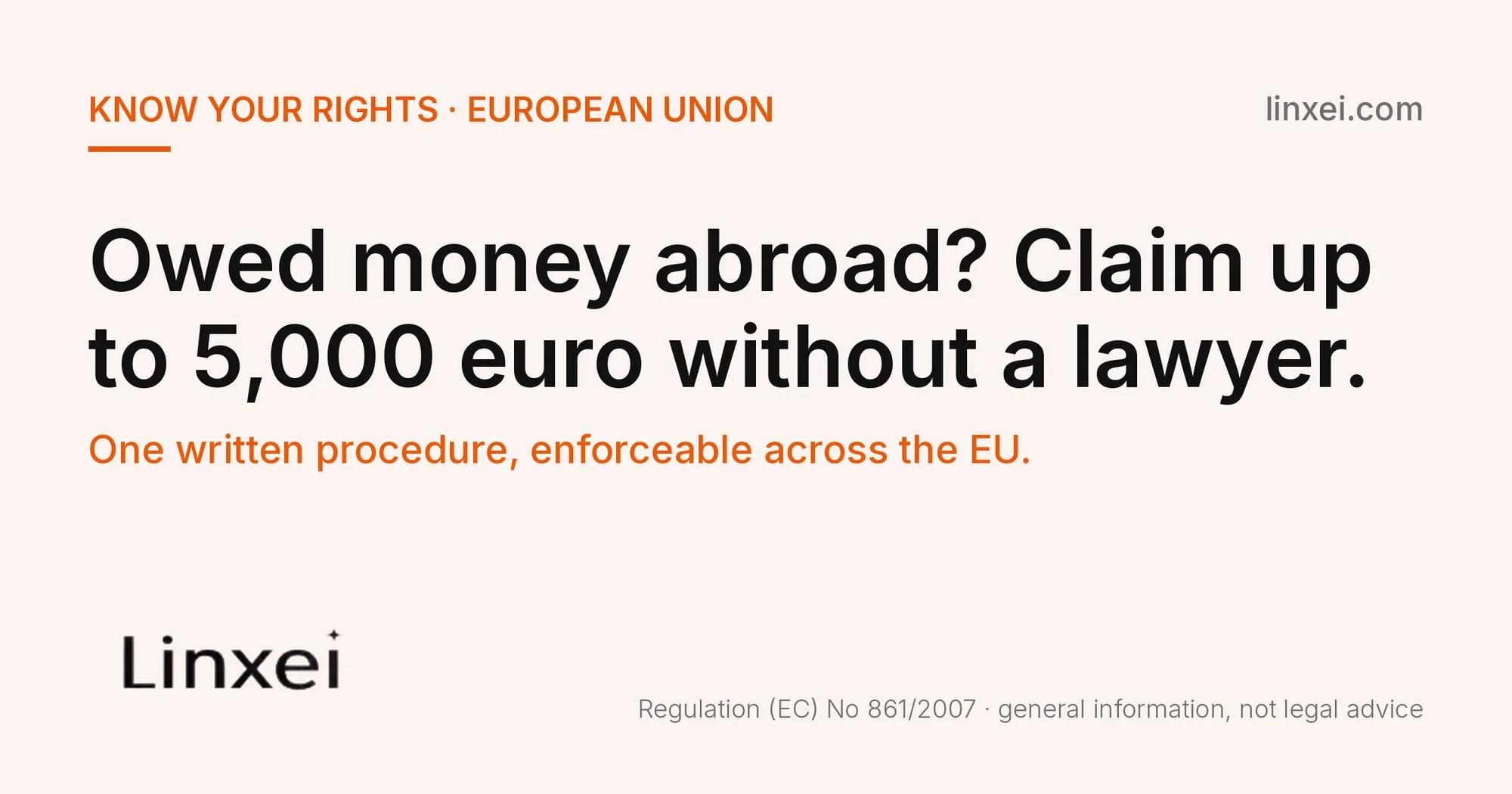
If someone in another EU country owes you money, there is a procedure designed for exactly that: a written, form-based process for cross-border claims worth up to 5,000 euro, excluding interest and expenses (Article 2(1) of Regulation (EC) No 861/2007). A lawyer is not compulsory (Article 10), and the resulting judgment is enforceable throughout the EU without further formalities (Article 20).
This article contains general information, not legal advice. What applies to your situation depends on your own circumstances, and on the national law of the country where you bring your claim.
What qualifies
The claim must be worth no more than 5,000 euro when the court receives the claim form, excluding interest, expenses and disbursements; that ceiling replaced the original 2,000 euro limit and has applied since 14 July 2017 (Article 2(1) of Regulation 861/2007, as amended by Regulation (EU) 2015/2421). It must be cross-border, which means at least one party is domiciled or habitually resident in a Member State other than that of the court seised (Article 3(1)).
What falls outside it
The procedure does not cover the status or legal capacity of individuals, matrimonial property, maintenance and family matters, wills and succession, insolvency, social security, arbitration, employment law, tenancies of immovable property apart from monetary claims, or violations of privacy and personality rights including defamation (Article 2(2) of Regulation 861/2007). Employment disputes are a common surprise on that list.
How it works
You start by filling in standard claim Form A and lodging it with the competent court, with supporting documents (Article 4(1) of Regulation 861/2007). It is a written procedure: the court holds an oral hearing only if it cannot decide on the documents or a party asks and the court considers a hearing necessary for a fair outcome (Article 5(1) and 5(1a)). The timetable is tight on paper. The court sends the claim to the defendant within 14 days, the defendant has 30 days to answer, the court forwards the answer within 14 days, and judgment should follow within 30 days of the response or of any hearing (Articles 5 and 7). In practice the court has three lawful ways to stop that clock, by seeking further details, taking evidence or summoning a hearing, so real cases often take longer than the timetable suggests.
You do not need a lawyer, but costs still follow the event
Representation by a lawyer or another legal professional is not mandatory (Article 10 of Regulation 861/2007), and Member States must provide practical assistance in filling in the forms (Article 11; see also the European e-Justice Portal). Court fees are set nationally, and must not be disproportionate or higher than for equivalent domestic simplified procedures (Article 15a). The unsuccessful party bears the costs of the proceedings, although the court will not award costs that were unnecessarily incurred or disproportionate to the claim (Article 16).
Enforcing the judgment elsewhere
A judgment given in the procedure is recognised and enforced in another Member State without any declaration of enforceability and without any possibility of opposing recognition (Article 20(1) of Regulation 861/2007). On request the court issues a certificate, Form D, at no extra cost. Enforcement itself follows the national rules of the country where you enforce, and the narrow ground for refusal is irreconcilability with another judgment between the same parties (European e-Justice Portal).
The Denmark exception
The procedure is not available for claims in Denmark (Your Europe on taking legal action). This follows from Protocol No 22 on the position of Denmark, under which Denmark did not take part in adopting the Regulation and is not bound by it, as recital 26 of Regulation (EU) 2015/2421 restates. Claims against a Danish defendant have to go through other routes.
How Linxei can help
A lawyer can tell you where you stand, put the claim properly and deal with the other side. Linxei is the platform where you describe your legal problem in your own words and verified independent lawyers send you fixed-fee offers. You choose. Jenni AI, our artificial intelligence, helps only to structure your request; it does not give legal advice, and a human lawyer always stays at the centre.
Have a legal question of your own?
Linxei is building AI-matched legal help with human justice at its heart. Add your voice and be first in line.
Add your voiceJennifer leads Linxei’s mission to make justice accessible, drawing on years inside the legal industry.
LinkedInRelated articles
Flight delayed or cancelled: what EU law entitles you to
Flight delay compensation in the EU: 250, 400 or 600 euro | Linxei
9 August 2026 · 4 min read
The 14-day cooling-off period for online and doorstep purchases
14-day right of withdrawal: cancelling an online order in the EU | Linxei
9 August 2026 · 3 min read
The two-year guarantee: your rights when goods turn out to be faulty
The EU two-year guarantee on faulty goods, and the new repair extension | Linxei
9 August 2026 · 3 min read