Buying a home in Ireland: the legal steps, from contract to registration
Buying a house in Ireland: conveyancing, stamp duty and closing | Linxei
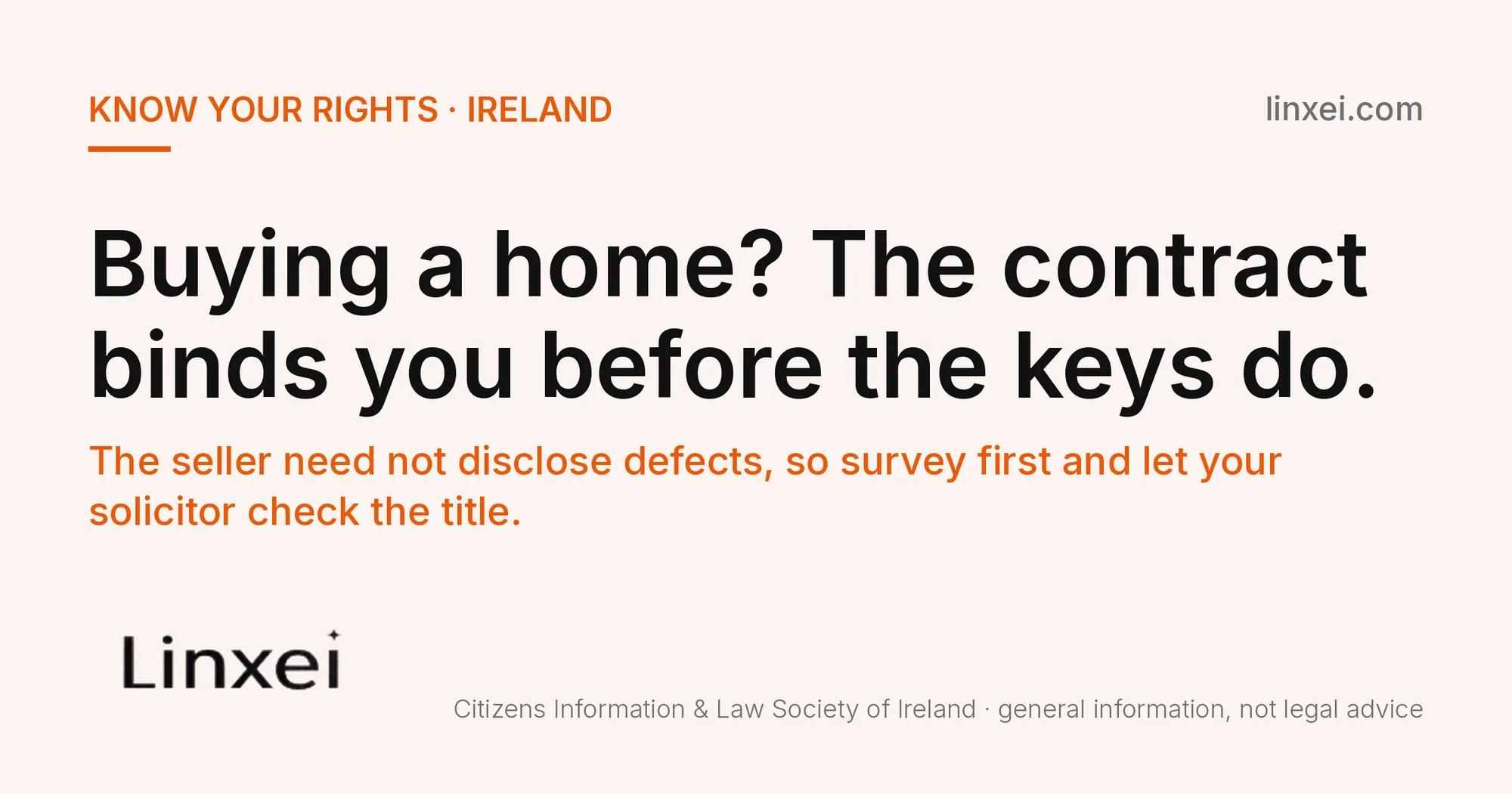
Buying a home in Ireland runs through a solicitor: conveyancing, the legal work involved in buying or selling property, covers the contract, title queries, closing and registration (Citizens Information). Two points matter before anything is signed: the contract for sale is binding, and the seller does not have to tell you about defects.
This article contains general information, not legal advice. What applies to your situation depends on your own circumstances.
What the solicitor does
The solicitor exchanges contracts, raises and negotiates title queries with the seller's solicitor, carries out title searches, drafts the closing documentation, closes the sale and then attends to stamping and registering your title (Law Society of Ireland). Standard pre-closing steps include Requisitions on Title, a set of questions about the property, and judgment searches against the seller (Citizens Information). Conveyancing charges vary between solicitors, so it is worth comparing several before you choose (same source).
The contract binds you
Once the contract for sale is signed, you are committed, and withdrawing can put your deposit at risk (Citizens Information). At auction the effect is immediate: you sign a binding contract there and then and pay a non-refundable deposit (Law Society of Ireland).
Get a survey first
A seller does not have to tell you about defects in a property, so before you finalise the purchase you should have it surveyed (Citizens Information). For second-hand homes the Law Society advises a structural survey by a qualified surveyor, architect or engineer before signing any contract (Law Society of Ireland).
Stamp duty
Stamp duty on residential property is tiered: 1 % on consideration up to EUR 1 million, 2 % on the portion over EUR 1 million and up to EUR 1.5 million, and 6 % on the portion above EUR 1.5 million, for instruments executed on or after 2 October 2024 (Revenue, stamp duty rates on residential property). The rates are marginal, so even on an expensive home the first million is charged at 1 %.
Registration, and when you actually own it
After closing, your deeds must be registered with the Registry of Deeds or the Land Registry, both operated by Tailte Éireann; registration can take months or even years, but you are the owner of the property in the meantime (Citizens Information).
How Linxei can help
A lawyer can assess your position, work out what you can claim and act within the time limits. Linxei is the platform where you describe your legal problem in your own words and verified independent lawyers send you fixed-fee offers. You choose. Jenni AI, our artificial intelligence, helps only to structure your request; it does not give legal advice, and a human lawyer always stays at the centre.
Have a legal question of your own?
Linxei is building AI-matched legal help with human justice at its heart. Add your voice and be first in line.
Add your voiceJennifer leads Linxei’s mission to make justice accessible, drawing on years inside the legal industry.
LinkedInRelated articles
La fianza del alquiler: cuánto pueden pedirle y cómo recuperarla
Devolución de la fianza del alquiler: plazos y límites legales | Linxei
6 August 2026 · 2 min read
Dépôt de garantie : le montant maximum et les délais pour le récupérer
Dépôt de garantie non rendu : montants, délais et majoration de 10 % | Linxei
6 August 2026 · 2 min read
Flight delayed or cancelled: what EU law entitles you to
Flight delay compensation in the EU: 250, 400 or 600 euro | Linxei
9 August 2026 · 4 min read